
Why Are Blank Puzzles So Popular?
Blank Puzzles are moving beyond simple entertainment. They combine creativity, concentration, and personal expression in one physical activity. A plain, unprinted surface can become a family scene, a classroom project, or a handmade gift. That open space creates immediate ownership.
Grand View Research estimates that the global jigsaw puzzle market reached about $1.3 billion in 2023. Its report also projects steady growth through 2030, supported by screen-free leisure and educational use. The Toy Association has similarly identified games and puzzles as resilient categories during periods of changing consumer spending. These figures suggest strong demand, although market definitions differ between reports. That limitation deserves attention.
Puzzle expert Will Shortz once said, “Puzzles are a way of life.” His words explain why Blank Puzzles feel different from mass-produced designs. They do not only ask people to solve something. They invite people to create the challenge itself. Imagine a child drawing a blue house, then watching relatives assemble it piece by piece. The activity becomes a memory, not merely a product.
This appeal also reflects today’s desire for slower, more meaningful recreation. Blank Puzzles encourage tactile learning, conversation, and quiet focus. They can reduce the pressure to achieve a perfect result. Still, their popularity should not be overstated. Some buyers may enjoy the idea more than the actual crafting process. That tension makes the category especially interesting.
Why Are Blank Puzzles So Popular?
Blank puzzles are unfinished puzzle boards with little or no printed artwork. Some contain plain white pieces. Others provide a faint outline for drawing, painting, or writing. The solver becomes part of the design process. That is the main difference from traditional puzzles.
Traditional puzzles usually offer a fixed image, clear colors, and a reference picture. Blank puzzles remove those visual shortcuts. Shape, texture, and personal marks become the clues. A blue piece may belong anywhere. A pencil line can become a border, or a mistake. It feels more like making than matching.
Industry data helps explain this growing interest. Grand View Research estimated the global jigsaw puzzle market at about USD 1.4 billion in 2023, with strong growth expected through 2030. Market figures vary by definition, but the direction is clear. Consumers still value offline, hands-on activities. The Toy Association has also reported continuing interest in games that support creativity and screen-free play. Blank puzzles fit both trends, although the evidence is not perfect.
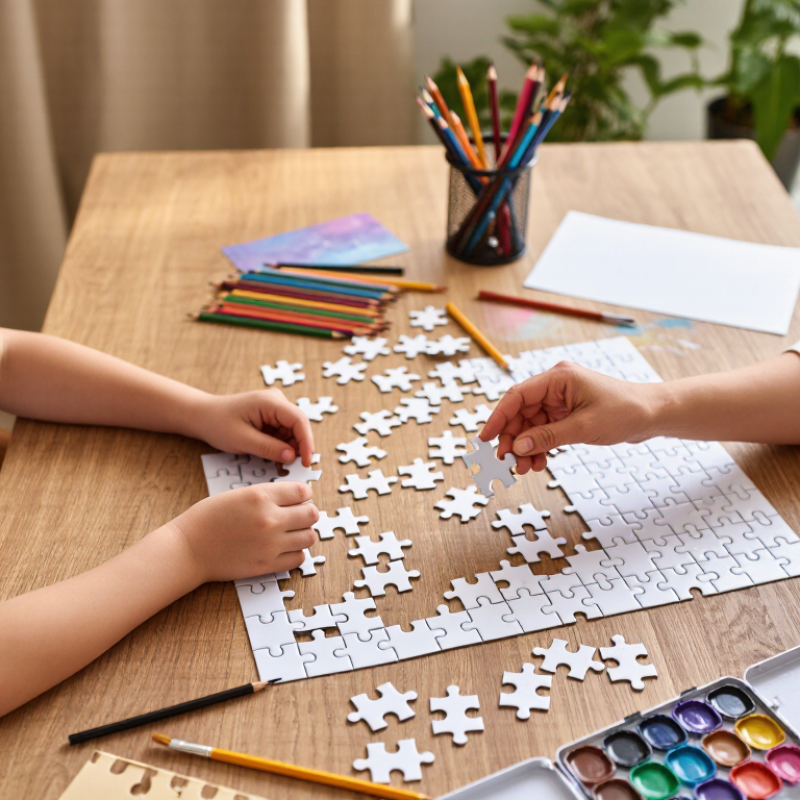
In practical use, a blank puzzle changes the table itself. You might see scattered wooden pieces beside colored pencils, a ruler, and an unfinished landscape. Traditional puzzles ask, “Where does this piece go?” Blank puzzles ask, “What should this become?” That freedom can feel exciting. It can also feel frustrating. Some users may miss a clear finish line. That weakness matters. A blank puzzle is not automatically better; it simply demands more ownership, patience, and willingness to rethink the image.
Blank puzzles are image-free puzzles that let the solver create, paint, or decorate the final design. Traditional puzzles use a pre-printed image as the main guide.
The chart compares defining format features. A value of 1 means the feature is characteristic of that puzzle format; 0 means it is not a defining feature. Blank puzzles stand out because they shift visual design and personalization from the manufacturer to the solver.
Why Are Blank Puzzles So Popular?
The Psychological Appeal of Creating Patterns from Nothing
A blank puzzle offers no picture to follow, only space, rules, and a quiet invitation. The empty grid can feel intimidating at first. Then one small mark changes it. A circle meets a line, and the mind begins testing possible relationships. This process turns uncertainty into a manageable visual problem.
The appeal lies in making patterns from nothing. Our brains naturally seek order, repetition, balance, and completion. Perception studies suggest that pattern detection supports attention and mental engagement, although responses differ between people. A solver may notice a row of pale squares, rotate a shape, and suddenly see structure. That moment feels earned because the pattern was not supplied. It emerged through observation.
In my own puzzle sessions, the best part is often the pause before certainty. I place a pencil beside the page, revise one assumption, and try again. The experience also exposes a weakness: I sometimes force symmetry where none exists. That mistake matters. It shows how strongly expectation can guide perception. Blank puzzles reward patience, but they do not guarantee insight. Their quiet challenge leaves room for curiosity, error, and a pattern that feels personally discovered.
The Psychological Appeal of Creating Patterns from Nothing
| Psychological Dimension | What the Player Does | Underlying Mechanism | Observable Benefit | Research Basis |
|---|---|---|---|---|
| Pattern Formation | Groups empty spaces, colors, shapes, or marks into a meaningful arrangement. | The visual system naturally organizes separate elements into patterns through principles such as proximity, similarity, and closure. | Immediate sense of order | Gestalt psychology; Wertheimer, 1923 |
| Autonomy | Chooses the subject, rules, colors, pace, and stopping point. | Personal control supports intrinsic motivation and makes the activity feel self-directed rather than externally imposed. | Higher personal ownership | Self-Determination Theory; Deci and Ryan, 2000 |
| Creative Fluency | Generates multiple possible designs instead of searching for one correct answer. | Open-ended tasks encourage divergent thinking, in which ideas are expanded before being evaluated. | More alternative solutions | Divergent-thinking framework; Guilford, 1950 |
| Cognitive Engagement | Tests arrangements, notices inconsistencies, and revises the emerging pattern. | Working memory and visual attention remain active while the player compares possibilities and makes local decisions. | Sustained attention | Research on working memory and attentional control; Baddeley, 2000 |
| Progress Visibility | Sees an initially empty surface become increasingly complete and coherent. | Visible progress provides feedback, helping effort feel connected to a concrete result. | Clear progress markers | Goal-setting and feedback research; Locke and Latham, 2002 |
| Flow Potential | Repeats small actions while adjusting difficulty through detail, speed, or complexity. | A close match between challenge and skill can produce deep concentration and reduced awareness of time. | Absorption in the task | Flow theory; Csikszentmihalyi, 1990 |
| Uncertainty Reduction | Transforms ambiguity into a recognizable image, sequence, or visual system. | The mind tends to seek coherence and may experience satisfaction when uncertainty is resolved. | Closure and completion | Gestalt closure principle; Köhler, 1929 |
| Low-Stakes Mastery | Makes mistakes, erases or changes them, and continues without serious consequences. | A safe environment supports experimentation and can strengthen perceived competence. | Greater willingness to retry | Self-efficacy research; Bandura, 1997 |
| Personal Meaning | Assigns memories, emotions, symbols, or identity to the self-created pattern. | Creative activity can support self-expression by converting internal ideas into an external, shareable form. | Stronger emotional connection | Research on creativity and self-expression; Runco and Jaeger, 2012 |
Blank puzzles are popular because they turn solving into making. A printed outline offers structure, but the empty surface leaves room for personal decisions. A child may draw a blue garden around the pieces. An adult may build a private map, memory, or imagined room. The puzzle becomes more than a finished picture. It becomes visible evidence of thought.
This freedom supports creative thinking. The World Economic Forum’s Future of Jobs Report 2023 ranked creative thinking among the most important workplace skills. Blank puzzles provide a small, low-risk place to practise it. Players test colors, symbols, textures, and layouts without needing perfect results. Some pieces do not fit. That is useful. A wrong choice can be moved, covered, or redrawn. Research on creative activity also often links hands-on making with stronger engagement and emotional wellbeing, although the evidence is not equally strong across every age group or puzzle format.
In practical use, the experience can feel surprisingly personal. Pencil marks remain beside erased lines. A child’s uneven sun may matter more than visual polish. Adults may discover that they prefer patterns over pictures. That preference is easy to overlook. Blank puzzles also invite shared authorship, because two people can disagree, revise, and leave traces of both perspectives. Their value is not only the completed object. It is the permission to create without following someone else’s image.
Blank puzzles turn uncertainty into a physical task. With no finished image to follow, every piece demands comparison, memory, and patience. That challenge can sharpen focus because attention narrows to shape, texture, and fit. Grand View Research estimated the global jigsaw puzzle market at about $1.33 billion in 2023, with strong growth expected through 2030. This expansion suggests that consumers value more than entertainment. They may also seek slower, screen-free activities.
Stress relief
Stress relief is another important factor. The American Psychological Association’s Stress in America 2023 report found that 27% of adults felt stress was so overwhelming that they struggled to function on some days. A blank puzzle offers a small, measurable win: one edge aligns, then another. Repetitive hand movements can create a calming rhythm, especially after work or during a quiet evening. The effect is not automatic. A difficult puzzle may frustrate someone already feeling mentally tired. I have also noticed that unfinished pieces can remain oddly demanding, even after the table is cleared. That imperfection matters. Blank puzzles do not remove stress; they give attention somewhere concrete to go. Their popularity may come from this balance between pressure and control, challenge and quiet.
Blank puzzles fit modern hobbies because they combine quiet focus with personal expression. A plain surface gives players room to draw, write, or design their own image. This changes the activity from simple assembly into a small creative project. It also suits short sessions. Someone can sketch for ten minutes, leave the table, and return later.
The social value is just as important. Friends can build one puzzle while sharing ideas across a kitchen table. Families may add small symbols, local memories, or private jokes. Afterward, a phone photo can show the finished design in seconds. Online sharing makes the hobby visible without requiring professional artistic skills. In community workshops, this low-pressure format often helps beginners participate comfortably. The puzzle becomes both an object and a conversation starter.
However, blank puzzles are not automatically enjoyable. Uneven drawings can make pieces difficult to recognize. Some people may feel pressure when their work is photographed and shared. That concern deserves attention. Clear lighting, honest captions, and permission from everyone involved make sharing more respectful. A practical approach is to test ideas on a few pieces first. The result may look imperfect, but that can reveal the maker’s process. For many modern hobbyists, that visible process feels more meaningful than a flawless picture.