
Blog
How to Choose Tech Rosewood Acoustic Slat Panels?
Choosing a Tech Rosewood Acoustic Slat Panel requires more than matching a warm wood color to your interior. The panel must suit the room’s sound, structure, lighting, and daily use. A home office may need speech clarity, while a restaurant needs reduced echo across hard surfaces. Measure the room before comparing finishes.
Look closely at the core, backing, slat spacing, and mounting system. These details influence both acoustic performance and installation time. Check tested absorption data, such as the noise reduction coefficient, rather than trusting attractive product photographs. Confirm the panel’s dimensions, weight, moisture resistance, and available fire documentation. Reliable suppliers should provide samples and clear technical specifications.
See the texture in person.
Rosewood tones can appear darker under warm lighting and cooler beside white walls. A sample also reveals uneven grain, edge quality, and possible color variation. Consider whether the surface will face chairs, luggage, pets, or frequent cleaning. Some decorative finishes look excellent at first but may show fingerprints or scratches more easily than expected.
Professional installation still matters. An uneven wall can create visible gaps, and poor fixing may weaken the acoustic result. Allow ventilation where the manufacturer requires it, especially on exterior-facing walls. I would not choose a panel only because it promises “maximum soundproofing.” Acoustic panels usually control reflection; they do not block every outside noise. That distinction is easy to miss. Comparing verified performance, practical durability, and honest project requirements will lead to a more dependable choice.
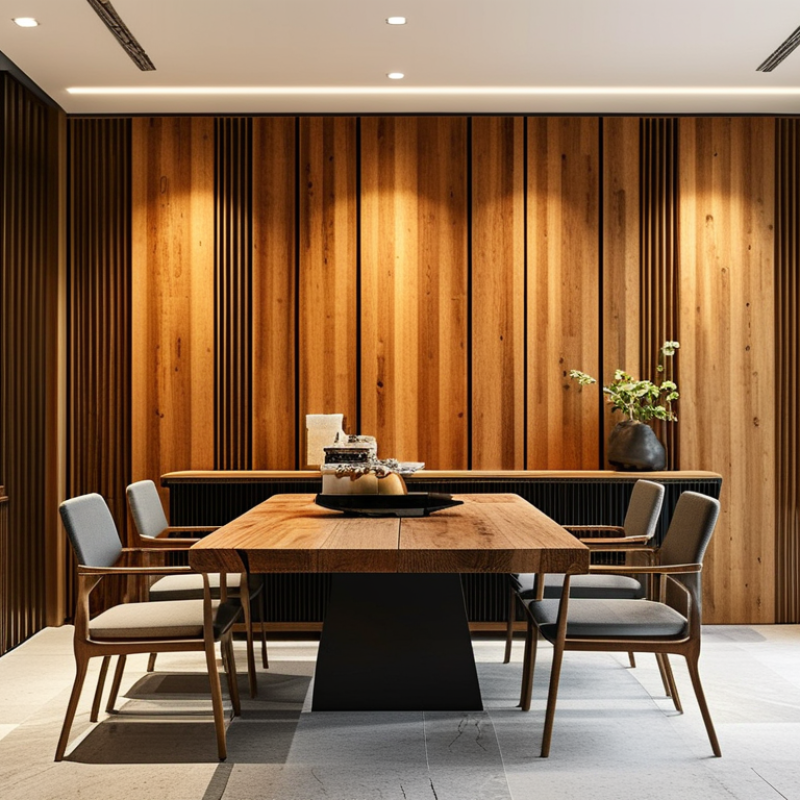
Understanding Tech Rosewood Acoustic Slat Panel Construction
How to Choose Tech Rosewood Acoustic Slat Panels?
Understanding Tech Rosewood Acoustic Slat Panel Construction
A Tech Rosewood acoustic slat panel usually combines decorative wood-finish slats, a stable core, and an acoustic backing layer. The slats create the visible rhythm. The backing absorbs and scatters sound. In many constructions, a wood veneer or durable laminate covers an engineered timber base. This helps control movement caused by changing humidity. It also keeps the panel lighter than solid hardwood.
Look closely at slat spacing and backing density. Narrow gaps may create a more continuous appearance, while wider gaps expose more acoustic felt. The felt should sit firmly behind each slat, without loose edges or uneven cuts. A rigid mounting board can improve stability, but it may reduce some sound absorption. Check the published acoustic test data, not only attractive product photographs. Test conditions matter.
Installation experience often reveals small weaknesses. A panel can look precise in a showroom yet show gaps after cutting. Measure the wall twice. Leave suitable expansion clearance near corners and ceilings. Use mechanical fixings appropriate for the wall substrate. Adhesive alone may be unreliable on dusty or uneven surfaces. I have found that lighting changes the perceived rosewood color significantly. Samples should be viewed in both daylight and warm indoor light. Construction quality matters more than a fashionable finish. Don’t overlook maintenance. Dust can collect inside the slat channels. A soft brush and gentle vacuum usually work better than excessive moisture.
| Category | Selection Criterion | Typical Construction or Specification | Why It Matters | Recommended Check Before Purchase |
|---|---|---|---|---|
| Panel Structure | Visible slats | Commonly made from a wood-based core such as MDF, finished with a rosewood-look decorative surface or veneer. Slat widths are often approximately 25–40 mm, with gaps commonly around 10–15 mm. | The slat-to-gap ratio affects the visual rhythm, open area, and amount of sound that can reach the absorber behind the slats. | Confirm the actual slat width, thickness, spacing, surface finish, and whether the stated “rosewood” refers to a decorative finish rather than solid rosewood. |
| Acoustic Core | Absorbing backing | Usually a porous acoustic backing, frequently PET felt or mineral-fiber material, installed behind the decorative slats. A black or dark backing is often selected to emphasize the shadow gaps. | Sound absorption is mainly provided by the porous backing and the air space, not by the hard decorative slats alone. | Request the backing material, thickness, density, recycled content, and technical data sheet. |
| Panel Dimensions | Standard module size | Many products are supplied in modular panels around 2400–3000 mm high and 500–600 mm wide, although dimensions vary by manufacturer and project. | Module size influences the number of joints, cutting waste, installation speed, and alignment of the slat pattern. | Match panel dimensions to the wall height, access conditions, door openings, electrical outlets, and transportation limitations. |
| Total Thickness | Panel depth | A finished slat panel is commonly about 20–25 mm thick. Installing it over battens or a service cavity can increase the overall depth to approximately 45–75 mm or more. | Greater depth can improve low-frequency absorption when it creates a larger air cavity, but it also reduces usable room space. | Measure the complete build-up: slats, backing, battens, fasteners, trims, and any required air gap. |
| Acoustic Performance | Sound absorption rating | Typical published ratings may fall within a broad range, often approximately NRC 0.55–0.95, depending on the backing, air gap, mounting method, and test configuration. | A rating from an independently tested assembly is more meaningful than a rating assigned only to the decorative panel material. | Look for a laboratory test report using recognized methods such as ISO 354 or ASTM C423, and verify the tested installation matches the proposed installation. |
| Frequency Control | Low- and mid-frequency absorption | Porous absorbers generally perform better at mid and high frequencies. A 50–100 mm air cavity can improve absorption at lower frequencies compared with direct mounting. | Speech intelligibility, music clarity, and reverberation control depend on absorption across the relevant frequency range, not only on a single overall rating. | Review octave-band or one-third-octave test results when designing meeting rooms, studios, restaurants, or classrooms. |
| Mounting Method | Direct fixing or batten installation | Panels may be fixed directly to a flat substrate or attached to timber/metal battens. Mechanical fasteners, construction adhesive, or both may be specified depending on the substrate. | Mounting affects acoustic performance, panel stability, alignment, fire performance, and future removability. | Confirm substrate requirements, fixing spacing, compatible fasteners, adhesive limitations, and whether a continuous air gap is required. |
| Surface Finish | Rosewood appearance | A tech rosewood appearance is generally achieved with printed film, laminate, engineered veneer, or another decorative coating over a stable core material. | Different finishes vary in color consistency, scratch resistance, UV stability, repairability, and cleaning requirements. | Request a physical sample and confirm the finish code, gloss level, grain direction, color variation, and replacement-panel availability. |
| Fire Safety | Reaction-to-fire classification | Fire performance depends on the complete assembly, including the slats, felt, adhesive, substrate, cavity, and installation method. Common project requirements may reference EN 13501-1 or ASTM E84. | A decorative finish or acoustic rating does not automatically indicate suitable fire performance. | Obtain a valid fire classification or test report for the exact panel assembly and intended mounting condition. |
| Moisture Resistance | Environmental suitability | Wood-based cores and decorative surfaces can be affected by humidity, liquid water, and repeated temperature changes. Interior dry areas are generally the safest application. | Excess moisture can cause swelling, edge damage, delamination, or dimensional movement. | Check the permitted relative humidity range and avoid wet areas unless the complete system is specifically rated for them. |
| Environmental Profile | Material transparency | Potential environmental attributes include recycled PET content, low-emitting adhesives, responsibly sourced wood fibers, and formaldehyde compliance. | Environmental claims should be supported by traceable documentation rather than appearance or marketing language alone. | Ask for recycled-content documentation, formaldehyde emissions data, VOC information, and any applicable environmental product declaration. |
| Maintenance | Cleaning and repair | Most finished slat panels are maintained with a soft brush, vacuum attachment, or lightly damp cloth. Excess water and abrasive cleaners should generally be avoided. | Open gaps can collect dust, while unsupported or damaged slats may be difficult to repair without replacing a module. | Confirm cleaning instructions, touch-up options, spare-panel availability, and the procedure for replacing damaged sections. |
| Installation Quality | Joint and pattern control | Panels should be installed on a straight, stable substrate with consistent vertical or horizontal alignment. Expansion allowances may be required around perimeters and penetrations. | Small alignment errors can be highly visible across a continuous slatted wall or ceiling. | Prepare a layout drawing showing panel joints, corner details, trims, outlets, switches, doors, and service access points. |
| Best Application | Room type and design goal | Suitable applications may include offices, reception areas, restaurants, hospitality interiors, home theaters, corridors, and feature walls when the required acoustic and fire specifications are met. | The right panel balances appearance, reverberation control, durability, installation depth, and regulatory requirements. | Define the room volume, existing reverberation problem, target use, wall area, budget, and compliance requirements before selecting the panel. |
| Technical note: The dimensions and performance ranges shown are representative industry values for slatted acoustic panel systems, not universal specifications. Final selection should be based on the exact product assembly, independently verified acoustic and fire test documents, installation method, and project conditions. | ||||