
Blog
How to Choose Laid Scrims Mesh Fabric for Your Project?
Choosing Laid Scrims Mesh Fabric is not simply a matter of selecting the highest strength or lowest price. The correct mesh must support your product, production process, and service environment. Textile composites researcher Dr. Subhash Anand offers a useful principle: “Performance begins with matching structure to service conditions.” That idea is easy to overlook.
A practical selection starts with the application. Will the scrim reinforce roofing membranes, insulation, flooring, packaging, or coated textiles? Each project demands different tensile strength, yarn spacing, basis weight, and flexibility. Check the machine direction and cross direction separately. They may not perform equally. Also examine coating compatibility, bonding temperature, moisture exposure, and expected handling during installation.
Small details matter.
A scrim that feels strong in your hand may still tear during lamination. A lightweight structure may reduce material use, yet create unwanted stretching. I have seen specifications fail because buyers compared only thickness and price. That approach is incomplete. Request samples, technical data sheets, and test results before approving bulk production. Review width tolerance, roll condition, adhesive behavior, and storage requirements. If the fabric will face outdoor exposure, ask about aging and dimensional stability.
There is no universal “best” Laid Scrims Mesh Fabric. The best choice fits the complete system. Sometimes, the first selection needs revision. That is not a failure; it is part of responsible engineering. A careful comparison can prevent wrinkles, delamination, weak seams, and expensive rework. This guide explains how to evaluate those factors clearly, question supplier claims, and choose a mesh that performs beyond the sample stage.
Understanding the Structure and Purpose of Laid Scrims Mesh Fabric
How to Choose Laid Scrims Mesh Fabric for Your Project?
Understanding the Structure and Purpose of Laid Scrims Mesh Fabric
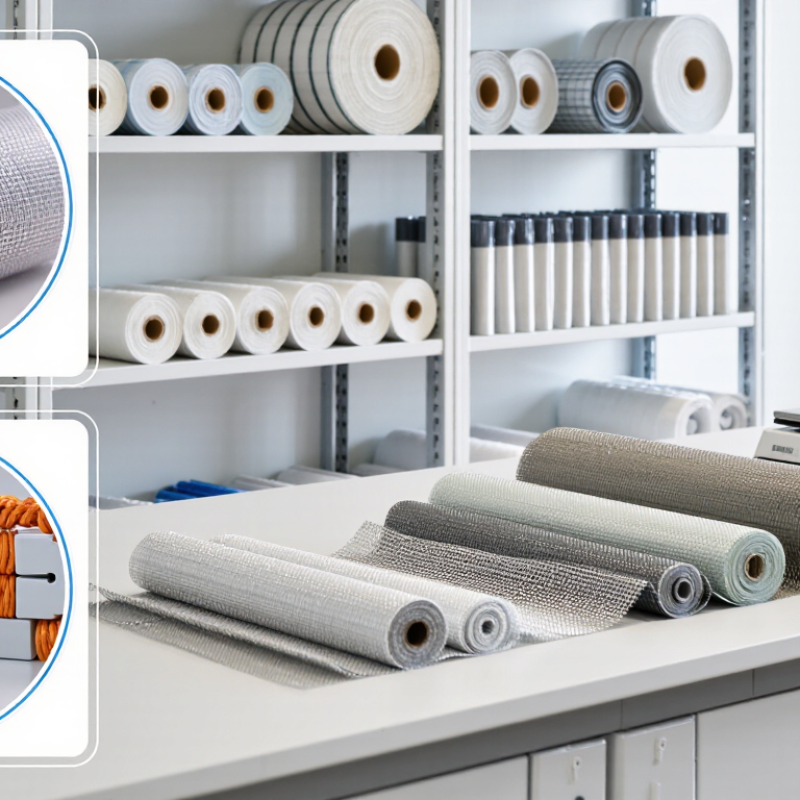
Laid scrims mesh fabric uses straight yarns arranged in warp and weft directions. Bonding points hold the grid together without weaving the yarns. This creates a lightweight reinforcement layer with stable dimensions. It can strengthen membranes, insulation facings, flooring systems, and composite panels. The open structure also allows coatings, adhesives, and resins to pass through.
According to Grand View Research, the global nonwoven fabric market reached USD 53.6 billion in 2022. It may grow at a 7.8% compound annual rate from 2023 to 2030. This wider market trend supports demand for efficient reinforcement materials, but it does not define every scrim application. Project conditions still decide the correct fabric. Check yarn type, mesh size, tensile strength, elongation, coating compatibility, and working temperature. Test before scaling.
A practical inspection starts with the roll. Hold it against light and check whether the openings remain even. Pull a small sample across both directions. Unequal stretch can reveal weak bonding or poor tension control. I have found that a heavier scrim is not always stronger in use. It may create unnecessary thickness or reduce flexibility. That choice matters. Ask for test data based on the final laminate, not only the dry fabric. ASTM D5034 and ISO 9073-3 can help compare tensile performance, although laboratory results may not reproduce every field condition. Real projects are less tidy. Therefore, prototype testing remains essential.
| Selection Dimension | Common Options | Typical Characteristics | Primary Purpose | Recommended Selection Guidance |
|---|---|---|---|---|
| Scrim Structure | Warp and weft grid | Continuous yarns are laid in longitudinal and transverse directions, then bonded at the intersections rather than woven over and under one another. | Provides dimensional stability while keeping the fabric lightweight and open. | Choose a laid scrim when reinforcement, tear resistance, and low added weight are more important than a dense barrier layer. |
| Yarn Material | Polyester | Flexible, lightweight, and resistant to many common chemicals. It is widely used in coated fabrics, roofing membranes, and laminated materials. | General reinforcement and improved tear strength. | Use polyester for flexible projects requiring balanced strength, handling, and cost performance. |
| Yarn Material | Fiberglass | High tensile strength, low elongation, good dimensional stability, and strong resistance to heat and many chemicals. | Reinforcement where movement and shrinkage must be minimized. | Use fiberglass for roofing membranes, wall coverings, insulation facings, and applications exposed to elevated temperatures. |
| Yarn Material | Polypropylene | Low density, moisture resistant, and resistant to many acids and alkalis. It generally has lower temperature resistance than fiberglass. | Lightweight reinforcement and moisture-tolerant composite construction. | Use polypropylene when low weight, water resistance, and chemical resistance are priorities at moderate temperatures. |
| Mesh Opening | Fine mesh: approximately 2–6 mm spacing | More yarns per unit area and smaller openings provide greater support for thin coatings, films, tapes, and laminates. | Controls cracking and improves surface integrity in thin or flexible products. | Choose fine mesh for thin laminates, adhesive tapes, surface coatings, and products requiring a smoother reinforcement pattern. |
| Mesh Opening | Medium mesh: approximately 6–15 mm spacing | Offers a practical balance between reinforcement coverage, flexibility, resin or coating penetration, and material consumption. | General-purpose reinforcement for membranes, insulation facings, and composite sheets. | Choose medium mesh when the project requires balanced mechanical support without excessive weight or stiffness. |
| Mesh Opening | Coarse mesh: approximately 15–25 mm spacing | Large openings reduce fabric weight and allow high penetration of coatings, adhesives, or cementitious materials. | Provides directional reinforcement with minimal obstruction to the surrounding matrix. | Choose coarse mesh for heavy coatings, construction membranes, and applications where open-area coverage is important. |
| Basis Weight | Lightweight: approximately 20–50 g/m² | Low fabric mass with limited contribution to overall thickness and flexibility. | Reinforces films, tapes, labels, and thin laminates. | Use lightweight scrim when maintaining flexibility, drape, and low shipping weight is essential. |
| Basis Weight | Medium weight: approximately 50–120 g/m² | Provides increased reinforcement while remaining suitable for many flexible laminated structures. | Supports roofing membranes, insulation facings, wall coverings, and industrial laminates. | Use medium-weight scrim for projects requiring a balance of tensile support, handling, and flexibility. |
| Basis Weight | Heavy weight: above approximately 120 g/m² | Higher yarn content can improve reinforcement, tear resistance, and dimensional control, but may increase stiffness and thickness. | Strengthens demanding membranes, heavy-duty composites, and construction products. | Use heavy scrim only when the additional strength justifies the increased mass, thickness, and material cost. |
| Tensile Direction | Balanced warp and weft strength | Similar reinforcement is provided in both principal directions of the grid. | Limits deformation during handling, installation, and service in multiple directions. | Choose balanced scrim for sheets, membranes, and laminates exposed to multidirectional stresses. |
| Tensile Direction | Warp-dominant or weft-dominant strength | One direction contains stronger or denser reinforcement yarns than the other. | Targets the main load path in directional products. | Choose directional reinforcement when the product has a known machine direction, installation direction, or primary stress axis. |
| Coating Compatibility | PVC, acrylic, polyurethane, bitumen, or cement-compatible finish | Surface treatments can improve adhesion, handling, wet-out, alkali resistance, or compatibility with a specific matrix. | Helps the scrim bond securely to the surrounding coating, adhesive, or composite material. | Confirm chemical compatibility, curing temperature, coating method, and required adhesion before purchasing. |
| Dimensional Stability | Low-shrinkage polyester or fiberglass | Maintains grid geometry during coating, lamination, drying, and temperature changes better than materials with higher thermal movement. | Reduces wrinkles, distortion, cracking, and loss of alignment. | Prioritize low-shrinkage constructions for wide webs, heat-assisted processing, and dimensionally precise laminates. |
| Flexibility and Drape | Fine polyester or polypropylene scrim | Thin yarns and lower basis weight generally provide better conformability around curves and irregular surfaces. | Allows the reinforced product to bend, fold, or conform without excessive stiffness. | Choose a flexible scrim for tapes, flexible packaging, soft membranes, and products requiring repeated handling. |
| Construction Application | Roofing and waterproofing membranes | Scrim reinforces polymeric or bituminous membranes and helps control dimensional change and tear propagation. | Improves service durability during installation and exposure to wind, temperature variation, and mechanical stress. | Review tensile strength, tear resistance, coating adhesion, heat stability, and compatibility with the membrane formulation. |
| Construction Application | Wall coverings and insulation facings | Open reinforcement grids can support coatings, facings, or laminated surfaces without creating a dense solid layer. | Reduces cracking and improves handling strength of thin facing materials. | Choose a fine-to-medium mesh with suitable adhesion to the facing compound or adhesive system. |
| Industrial Application | Adhesive tapes and laminates | Scrim improves tear resistance and dimensional control while allowing the tape or laminate to remain flexible. | Prevents excessive stretching and helps provide clean, controlled tearing where required. | Match scrim weight, mesh size, and elongation with the tape backing, adhesive coat weight, and intended tear behavior. |
| Testing Requirements | Tensile strength, elongation, tear resistance, shrinkage, adhesion, and basis weight | Performance depends on yarn material, linear density, mesh spacing, bonding method, coating, and test direction. | Provides measurable confirmation that the scrim meets the project’s mechanical and processing requirements. | Request technical data measured in both warp and weft directions under recognized test methods suitable for the final product. |