2026 Best Sand Candles Suppliers for Global Buyers?
In 2026, Sand Candles are moving beyond novelty décor. They now serve boutique hotels, wedding planners, gift brands, and homeware retailers worldwide. Buyers need more than attractive product photos. They need consistent texture, stable burning performance, clear packaging details, and dependable delivery schedules. This guide introduces practical supplier considerations for international purchasing teams.
A reliable supplier should explain the sand material, wax composition, wick type, fragrance options, and expected burn time. Product samples matter. A candle may look smooth in a catalog but crumble during handling or burn unevenly in testing. Ask for sample photos, batch information, safety documentation, and packaging specifications before placing a large order. Strong suppliers should also communicate minimum order quantities, lead times, payment terms, and replacement policies clearly.
Certification requirements differ between markets, so buyers must verify current local rules independently. Packaging should protect the product from moisture, heat, and abrasion during long-distance transportation. Recyclable containers and reduced plastic can support sustainability goals, though these claims deserve evidence. Not every supplier offers genuine customization. Some only change labels or colors. Others can develop shapes, scents, gift boxes, and private-label collections.
This guide compares supplier strengths for different business needs, including low-volume testing and larger wholesale programs. It also considers communication quality, production experience, export readiness, and quality-control habits. One limitation remains: supplier performance can change after publication. Recheck samples, documents, and quotations before commitment. Small details often reveal the real difference.
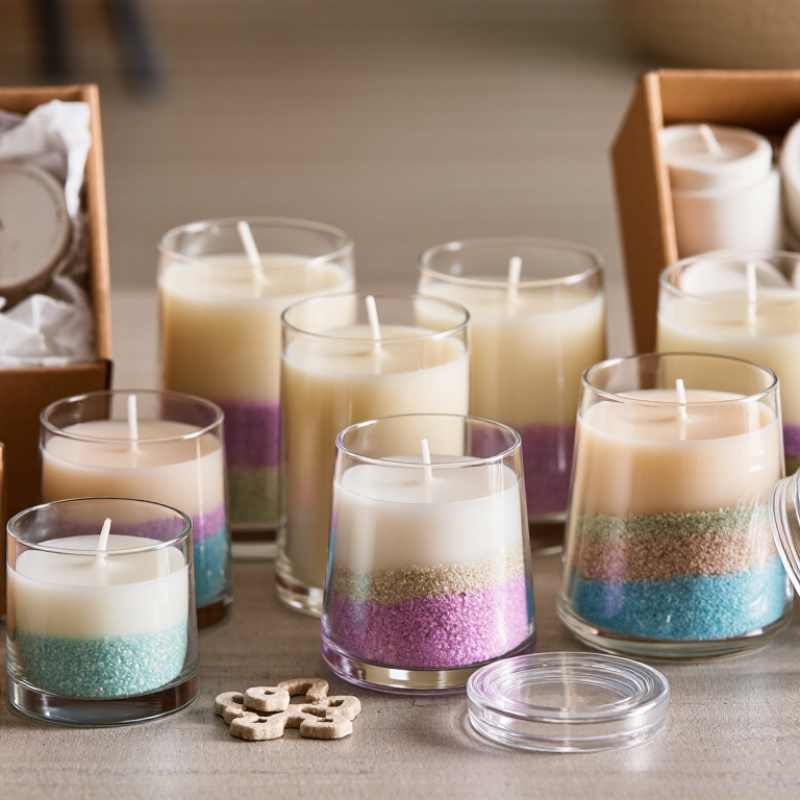
Sand Candle Market Definition and 2026 Demand Baseline (CAGR: 5.7%)
Sand candles are loose wax granules poured into a heat-resistant vessel, then fitted with a wick. Buyers can reshape the candle after each burn. This creates demand for refill packs, decorative jars, and small event supplies. The 2026 planning baseline uses a 5.7% CAGR, aligned with current growth estimates for the broader candle and home-fragrance category. Grand View Research reports continued expansion in scented candles, supported by home décor and gifting demand. Sand candles remain a smaller niche, so this rate should be treated as a working benchmark, not a guaranteed result.
Trade data from UN Comtrade can help suppliers measure related wax, candle, and household-decoration flows. Euromonitor’s home and lifestyle research also points to consumers seeking affordable sensory products for personal spaces. In practice, buyers often check grain size, melting behavior, wick stability, fragrance documentation, and packaging damage. A sample may look attractive but burn unevenly. That matters. Climate also affects logistics; heat exposure can cause clumping before delivery. Demand estimates are imperfect because sand candles are not always classified separately in customs databases.
Tips: Request a pre-shipment burn test using the exact vessel and wick. Compare refill weight, burn time, scent consistency, and carton protection. Ask for batch records and safety documentation. Do not rely on photographs alone. A realistic 2026 purchasing plan should include seasonal gifting, hospitality décor, and repeat refill demand, while leaving room for slower regional adoption.
Supplier Classification by Capacity, MOQ, Lead Time, and HS 3406 Trade Data
2026 Best Sand Candles Suppliers for Global Buyers?
Global buyers should classify sand candle suppliers by production capacity, not catalog size. Small workshops may produce 5,000 units monthly and offer flexible colors, shapes, and packaging. Mid-sized factories often handle 20,000 to 80,000 units. Large exporters may exceed 100,000 units, but customization becomes less flexible. Ask for monthly output, machine capacity, backup labor, and recent production records.
MOQ changes with the product. Stock items may start at 500 pieces, while private packaging can require 2,000 or more. Lead time usually ranges from 15 to 45 days after artwork approval. Add time for sample testing, carton inspections, and port scheduling. A short promise can sound attractive. It may still be unrealistic during peak seasons.
HS 3406 trade data helps compare importing countries, shipment frequency, declared values, and supplier concentration. However, customs descriptions are not always consistent. Sand, wax, fragrance, and container materials may affect classification or valuation. Buyers should verify the applicable tariff code with a licensed customs professional in the destination market. I would not rely on one database alone. Compare several shipment records, then request invoices, packing lists, test reports, and production photos. Small details matter, such as wick centering, wax surface cracks, carton drop resistance, and moisture protection. A supplier with transparent records is usually easier to audit, even when its price is not the lowest.
Material and Safety Verification Using ASTM F2417 and EN 15493 Standards
For global buyers, sand candles should be evaluated as engineered candle products, not decorative sand alone. ASTM F2417 examines candle fire safety, including flame height, secondary ignition, and stability. EN 15493 addresses similar risks for the European market, including safe burning behavior and resistance to tipping. Ask suppliers for recent, batch-linked test reports, wax specifications, wick details, fragrance documentation, and vessel measurements. A generic certificate is weak evidence. It may describe another product.
Material checks deserve equal attention. Confirm the sand is clean, dry, and free from visible debris or sharp particles. Request SDS documents for waxes, dyes, and fragrances, plus traceable production records. The NFPA report Candle Fires in U.S. Home Structure Fires estimated about 7,400 such fires annually from 2014 to 2018, with approximately 90 deaths and 680 injuries. These figures show why attractive packaging cannot replace controlled testing. In practice, buyers should burn samples under repeated conditions. Small changes in wick length can alter flame height. That detail is easy to miss.
Tips: Request ASTM F2417 and EN 15493 reports from an accredited laboratory. Match the report’s product code, size, wax, wick, and vessel to the offered sample. Check warning labels and burn instructions in the destination language. Do not rely on a single pre-shipment test. Real-world storage, transport vibration, and humidity can expose weaknesses. A supplier may meet the standard once, yet still need stronger process controls.
2026 Best Sand Candles Suppliers for Global Buyers? - Material and Safety Verification Using ASTM F2417 and EN 15493 Standards
Anonymized buyer-screening matrix for sand candle materials, documentation, production capability, and safety verification
Procurement comparison table
Supplier identities are intentionally omitted. ASTM F2417 and EN 15493 are fire-safety specifications used for verification; buyers should request current test reports, samples, and batch-level records before placing an order.
| Supplier Record | Primary Sand Candle Format | Wax System | Container / Sand Material | Wick Construction | Typical Product Size | Indicative Burn-Time Range | ASTM F2417 Evidence | EN 15493 Evidence | Material Traceability | MOQ / Lead Time | Buyer Verification Priority |
| Supplier Record 01 | Loose sand-filled vessel candle | Paraffin blend | Heat-resistant glass; mineral sand fill | Pre-waxed cotton wick | 150–250 g | 25–45 hours | Report available
Confirm product-specific scope | Report available
Confirm latest revision | Wax lot, wick lot, vessel declaration | 500 units / 30–40 days | Low |
| Supplier Record 02 | Decorative sand candle in metal tin | Soy-paraffin blend | Coated steel tin; colored mineral sand | Braided cotton wick | 100–180 g | 18–32 hours | Partial file
Retest finished configuration | Report available
Check tin and wick configuration | Supplier declarations; batch coding required | 1,000 units / 35–45 days | Medium |
| Supplier Record 03 | Layered sand candle with embedded insert | Hydrogenated vegetable wax | Borosilicate glass; washed silica sand | Lead-free cotton wick | 180–300 g | 30–55 hours | Pending
Finished-product test required | Pending
Verify flame and stability results | Wax origin and sand particle specification | 300 units / 40–50 days | High |
| Supplier Record 04 | Refillable sand candle vessel | Beeswax blend | Thick soda-lime glass; natural sand | Flat-braided cotton wick | 200–350 g | 35–65 hours | Report available
Review refill instructions | Partial file
Test vessel and refill together | Wax, wick, glass, and sand records | 250 units / 45–60 days | Medium |
| Supplier Record 05 | Outdoor sand-filled candle pot | Paraffin wax | Aluminum cup; coarse mineral sand | Paper-cored cotton wick | 250–450 g | 40–75 hours | Pending
Confirm heat and tip-over testing | Pending
Verify intended-use limitations | Metal declaration and wax batch record | 1,500 units / 30–45 days | High |
| Supplier Record 06 | Mini sand candle gift set | Soy wax | Glass jars; fine colored sand | Cotton wick with metal tab | 60–100 g per candle | 10–20 hours | Report available
Review multi-pack sampling | Report available
Confirm label and warning review | Component declarations and production date | 2,000 sets / 25–35 days | Low |
Recommended buyer checks before approval
Request a test report identifying the exact finished candle configuration; verify wax, wick, vessel, sand, dye, and fragrance specifications; review flame behavior, secondary ignition, tip-over stability, container temperature, warning labels, and traceability records; then approve a production sample rather than relying only on component-level documents.
Data fields are presented as an anonymized procurement-screening example. Burn-time, MOQ, lead-time, and documentation status must be confirmed directly with each supplier for the 2026 purchasing cycle.
Global Cost Comparison: FOB Prices, Duties, Freight, and Incoterms 2020
For global buyers, sand candles require more than a factory price. In 2026, compare the FOB quotation with the complete landed cost. Under Incoterms 2020, FOB generally applies to sea or inland waterway shipments. The seller loads the goods onboard at the named port, while the buyer arranges ocean freight, insurance, import clearance, and destination delivery. Confirm the exact port and transfer point in writing.
Duties depend on the product’s customs classification, declared value, origin, and destination country. Ask suppliers for carton dimensions, gross weight, candle composition, and a draft commercial invoice. Freight can change sharply when one carton becomes a full pallet. A practical comparison should include FOB cost, export charges, ocean freight, insurance, duty, taxes, port fees, and local delivery. Our first estimate was usually too optimistic when destination handling fees were missing. Small errors matter.
Tips: Request two quotations using the same specifications. Compare FOB and another suitable Incoterm, such as CIF or DAP, but check what each price excludes. Order a sample and measure burn quality, packaging strength, and candle weight. Use an independent pre-shipment inspection for larger orders. Keep a cost sheet with currency, validity dates, and estimated transit time. Freight rates are not fixed. Recheck them before payment.
Supplier Scorecard: Certifications, Defect Rates, ESG Data, and Buyer Risk
For global buyers, the best sand candle suppliers in 2026 should pass a practical supplier scorecard. Certifications matter, but only when documents are current, traceable, and relevant to production. Request certificate numbers, issuing bodies, scope, and expiry dates. Verify whether the certificate covers the actual factory, not only a trading office.
Defect rates need careful reading. A supplier reporting 0.5% defects sounds strong, yet the figure may exclude color variation, cracked glass, weak wicks, or damaged cartons. Ask for the inspection standard, sample size, and last twelve months of records. Request pre-shipment photographs and test samples from different production batches. Small details reveal process control. Sometimes, records look too clean.
ESG data should include measurable evidence. Review energy use per unit, recycled packaging content, worker training hours, wastewater controls, and corrective-action logs. A polished sustainability statement proves little without dates and supporting data. Ask how wax, sand, fragrance, and packaging materials are sourced. Supplier responses may be incomplete. That is useful information, not an immediate rejection.
Buyer risk also includes lead-time volatility, single-factory dependence, payment exposure, and weak communication. Score each area from one to five, then document the reason behind every rating. A factory visit or independent audit can test whether written procedures match floor-level practice. Keep a backup supplier for seasonal demand. Reliability is built through repeated evidence, not attractive samples.
2026 Best Sand Candle Suppliers for Global Buyers
Supplier Scorecard: Certifications, Defect Rates, ESG Data, and Buyer Risk
How to read this chart: The scorecard shows the recommended number of evidence fields a global buyer should verify before approving a sand candle supplier. The checklist covers ISO-based quality and environmental documentation, 12-month defect-rate records, ESG metrics aligned with the GHG Protocol, supply-chain traceability, and buyer-risk controls. It is a standardized due-diligence framework, not company-level performance data.
Reference framework: ISO 9001 quality management, ISO 14001 environmental management, GHG Protocol emissions accounting, OECD responsible business due diligence, and documented corrective-action practices.